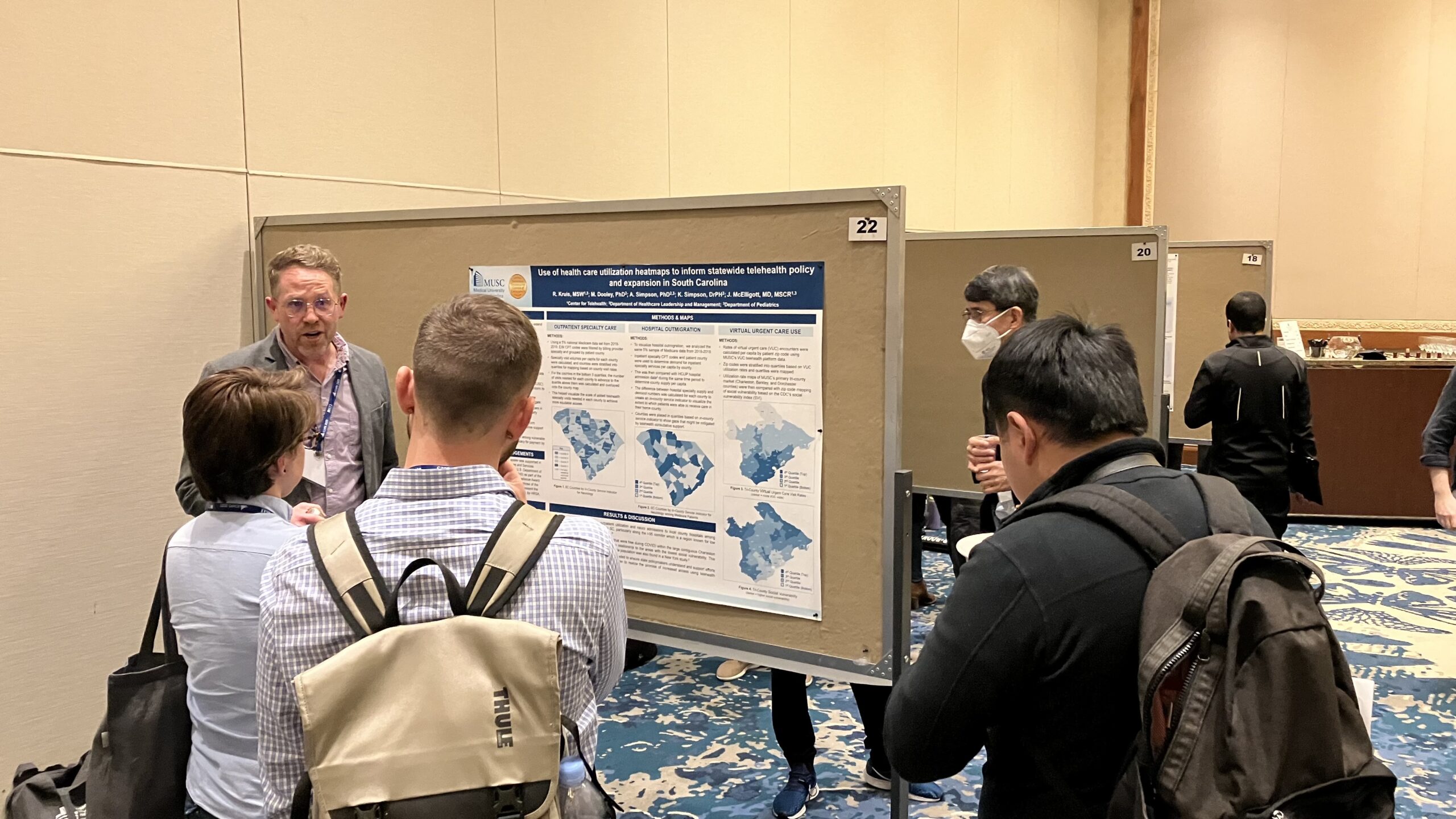
Members from the MUSC Telehealth Center of Excellence Team presented findings at the International Conference on Health Policy Statistics

Members from the MUSC Telehealth Center of Excellence team presented findings at the International Conference on Health Policy Statistics held January 9-11 in Scottsdale, AZ. The theme of the conference was Upgrading the Pipeline from Health Data to Health Policy, providing the MUSC COE a unique opportunity to discuss methods for managing and analyzing telehealth data and using telehealth data to inform policy.


Ryan Kruis (Director, Research & Grants, Center for Telehealth) presented the team’s work using claims and administrative data to map utilization of healthcare services to guide strategic deployment of telehealth services to mitigate access to care issues.

Use of health care utilization heatmaps to inform statewide telehealth policy and expansion in South Carolina | Kruis, MSW; M. Dooley, PhD; A. Simpson, PhD; K. Simpson, DrPH; J. McElligott, MD, MSCR


Dr. Daniel Brinton (Assistant Professor, College of Health Professions) presented innovative methods for combining intensive care EHR data to aid outcome analysis. These methods have been used on a number of COE ICU projects.

Matching irregular EHR intensive care data to create an accurate & analyzable dataset | Brinton, PhD; A. Goodwin, MD, MSCR; Annie Simpson, PhD


Both presentations were met with great enthusiasm among conference participants, which included leading experts on the use of data and statistics to analyze and inform health policy.

MUSC remote patient monitoring team recognized at the American Academy of Nursing Health Policy Conference

The Medical University of South Carolina (MUSC) Center for Telehealth team partnered with Stel Life, Inc. to present the results of their innovative “Not Home Alone:  A COVID-19 Post-Discharge Remote Patient Monitoring Pilot” program at the October 2022 American Academy of Nursing Health Policy Conference in Washington, D.C.

The COVID-19 pandemic caused many hospitals, including the MUSC hospitals, to exceed capacity, delaying acute care for certain patients. MUSC’s multidisciplinary telehealth team designed a remote patient monitoring service that allowed COVID-19 patients with acute hypoxic failure requiring continued oxygen therapy to be safely discharged to home.  Over 50 patients used the Stel Vitals Hub to transit biometric data, including oxygen levels, twice a day to a nurse care manager.  Hospitalist physicians were immediately available to conduct tele-visits if needed.  Seventy-seven percent of the patients attended the 2-week post-discharge appointment with their primary care physician, and eighty-eight percent had already weaned off the oxygen at home.  This program also opened up inpatient and emergency department capacity, allowing MUSC to accommodate critically ill patients from surrounding communities during this time of hospital surge and limited bed availability.

You can view the poster presented at the American Academy of Nursing Health Policy Conference here.

---

The MUSC Center for Telehealth is recognized as one of only two Telehealth Centers of Excellence in the United States, awarded by the Health Resources and Service Administration (HRSA). MUSC was awarded this national designation in 2017 because of the Center's successful telehealth programs with a high annual volume of telehealth visits, substantial service to rural and medically underserved populations through telehealth, and its financially sustainable telehealth models. The role of the COE is to fill important knowledge gaps in the national telehealth landscape through research, regional and national collaborations, and proactive dissemination of telehealth resources. www.telehealthcoe.org

Stel Life offers its Vitals Hub and secure patented technology to transmit home biometric data directly to the patient’s electronic health record for review by care teams.  The Stel technology does not require Wi-Fi, apps or smart devices providing a frictionless home monitoring experience for both patients and the care team.  Stel has transmitted 2 million vital signs from the homes of individuals managing acute and chronic illness across the United States. www.stel.life

Prev
12
Next